


Grief Has many Faces
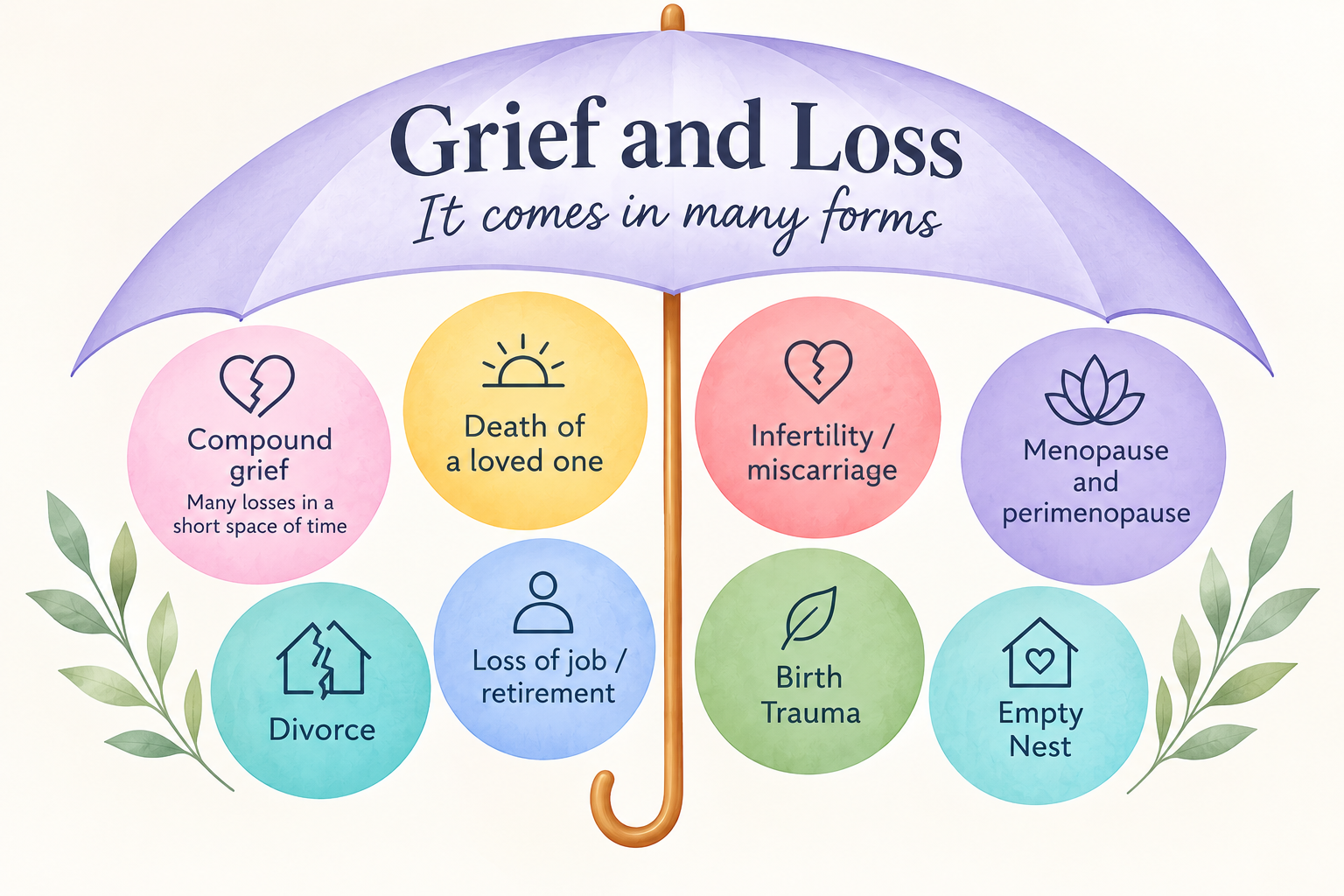
Life’s transitions can be difficult to navigate, and sometimes leave us grieving what we have lost through the process.
Relationships, dreams, identities, expectations and the life we thought we were going to have.
Compound Grief is especially difficult because you don’t have time to grieve the first loss before another one happens.
Sometimes a big life transition happens such as a death, divorce, or redundancy; or a few major losses happen all around the same time, and you are forced to reevaluate your life.
It can leave you feeling broken and overwhelmed.
You lose an identity that was a big part of you, like a job or a title, or your status as a wife.
It can be so hard to get past these types of losses because you feel like you’ve lost a part of you.
Maybe you thought you’d be a mother, but now it’s too late; Or you’d planned to have a career which never happened because you chose to have a family instead.
These losses only dawn once it's too late and can leave you feeling devastated and stuck wondering “what if, if only..”
You’re left with no idea of what you are
supposed to be doing with your life. It's like everything has just fallen away.
When you feel like this, you look back on your life and wonder why it’s all changed.
How did it get this bad?
Who have I become?
What do I do now?
You don’t recognise yourself.
You’ve realised that you can’t just talk your way out of this. You can feel it in your body and it needs to be addressed at that level.
You’ve probably already tried processing your grief with talking therapy, or talking to friends. Maybe you've tried writing sad poems or songs or doing a little ceremony to try and let go, but you still feel no better.
Grief can cause you to hold onto patterns of tension, across your chest or shoulders or in your jaw; bracing against an impending doom, like you are carrying the world on your shoulders.
I’m suggesting a
different way to process your grief, a gentle method to release the tension held in your body, and change the negative thinking patterns in your mind.
When your body holds onto grief in tension, it often presents as a painful back, tight shoulders, digestive problems, or disturbed sleep.
You can become stuck in patterns of negative thinking, feelings of hopelessness, leading to depression, and anxiety that make you want to curl up into a ball and hide away from the world.
It’s as if
the real you is trapped somewhere inside a malfunctioning body
Living with grief puts you into survival mode, and these are all common symptoms.
Grief doesn't have to define you, life’s transitions don’t have to be so hard, even when it’s devastating and feels impossible to go on.
You don't have to hold onto these unhelpful patterns of tension in your body.
You don't have to hold onto the grief.
The solution is to let it go, but you’ve never been shown how.
And so instead the tension builds, causing you to hold on more tightly, and keep repeating those unhelpful patterns of holding on, leading to discomfort, distress and sometimes even chronic pain.
It's time to let it go.
You know you need to sort this out.
This is a set of tools that you can use to gently process the grief in a way that helps you to stop reacting and start responding to the world from a place of inner composure.
The beauty is that you also have them to continue using throughout your life.
What I offer is a simple
toolkit of solutions that help to get to the root of your problem, and keep on top of it, so that you feel better for longer and are more able to cope with those difficult days.
The tools are accessible, enjoyable and easy to fit into your daily routine.
Short practices that you can sneak into a five or ten minute break, or after a long drive, or at the end of a busy day.
Practices that will relax you before you go to sleep. Because, right now, I know that you don’t have the energy for learning something that takes a long time, or your body hurts, so you need to take a gentle approach.
These methods are tailored to your individual needs and can be safely practiced at home without having to sign up for years of expensive therapies and classes.
I provide simple, practical support to help you to process and heal from your grief, understand what you're experiencing and finally find some peace and contentment so that you can move forward with your life.